
As selling through multiple channels grew more common, merchants were running into disjointed experiences, because Shopify had built for one channel at a time.
The company was weighing whether to build channel awareness into Admin or buy its way there, and the team was asked to work out what multi-channel could look like. I focused on the criteria that decision should be judged against, particularly product publishing and catalogue management.
Role
Product Designer
Company
Shopify
Timeline
Team
2 other product designers, 1 content designer
Tags
Product Strategy, Visioning, Interaction design, Visual design
Context
“The future of Shopify is multi-channel”
— Tobi Lütke, Shopify CEO

Merchants increasingly sold outside the Shopify Online Store, on marketplaces like Etsy and Walmart and social platforms like Instagram and TikTok, each with each with its own capable built-in selling tools.
Shopify built a bespoke integration per channel, with partners carrying much of the build and maintenance. Merchants got inconsistent, unreliable, poorly integrated experiences that each looked and worked differently.
The clearest evidence we were failing was that a market of third-party aggregator apps existed purely to do the job Shopify wasn't doing.
Experiences that varied across sales channels


Opportunity
Instead of optimising channels for Shopify, how can we optimise Shopify for channels?
The standing question was: build channel awareness into Admin, or acquire a consolidator. Codisto, later relaunched as Shopify Marketplace Connect, was a key moving piece while we worked.
My role was to map the merchant lifecycle by jobs to be done, which then evolved into frameworks for product publishing and catalogue management.
Merchant lifecycle


Publishing models
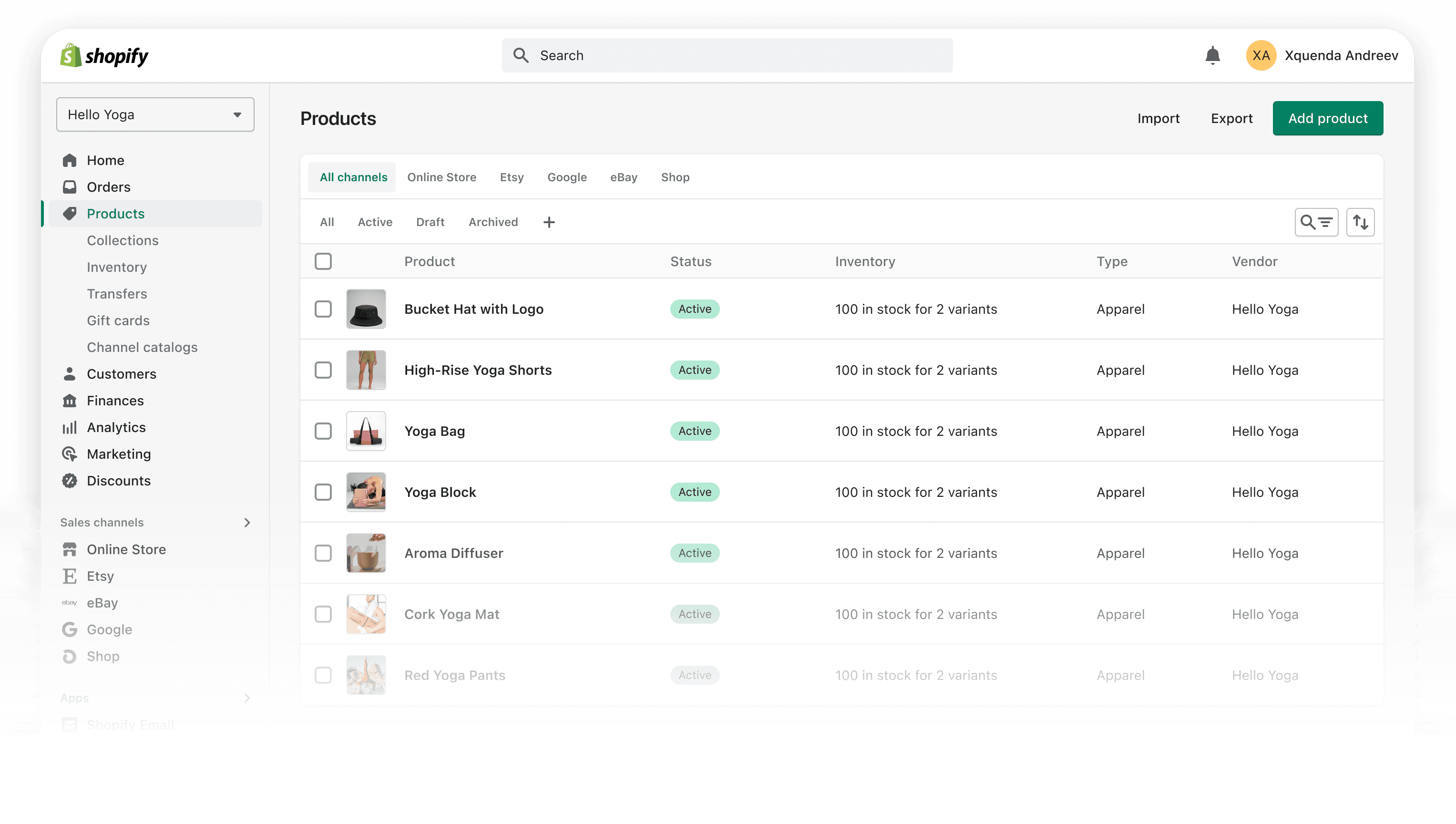
Admin supported one product at a time. Create a product, add common attributes, adjust what each channel requires, publish, repeat. It did not support the batch flow, where merchants could create many products, hold them as drafts, bulk edit for one channel, publish, then bulk edit for the next.
This exposed a limitation: Admin's mental model assumed one product going to one place. From there, we audited hundreds of attributes across different channels, and then came up with some concepts for how this could work.
Evolving workflow models for scale


Improve management of single products - concept
Integration modes
Rather than bring one concept, I set out four ways Admin could relate to channels and mapped them against merchant workflows. I made the case for progressive integration, and I held the view that the product index was core enough to be kept in Admin, especially for a product that claims to be the merchant's system of record.
However, progressive integration has its own cost. It keeps Admin as the centre of gravity with huge builds on the core surface, and adds weight there for merchants who may never use a channel.
Evolving workflow models for scale


Hub & spoke
Same experience as synced products in individual sales channels today.

Progressive integration
Concept where merchants can easily launch a channel-based bulk editor directly from Admin.

Visibility only
Concept of a channel hub, where only the status of products is shown on Admin, and workflows still live in channels.

Consolidator
Merchants manage products from a separate surface outside of Admin. Reference point is Markets product and pricing today, which deviates from the source of truth on Admin.

Closing thoughts
In the end, Shopify did both progressive integration and consolidator modals, split by channel type.
Marketplaces went the buy route. Codisto was acquired and relaunched as Shopify Marketplace Connect, one app connecting the catalogue to Amazon, eBay, Walmart and others. Other channels are managed inside Admin, bound to specifications that declare what each platform requires.
My key learning was how to judge what belongs in the core Admin. The test is not how important a channel is. It is whether the core data model can carry that channel's requirements without a second copy of the catalogue. Marketplaces need strict categorisation, unique attributes and more complex status information than Admin supports, so they earn their own surface. Most channels do not.
This segmented modal was a considered balance between cost of maintenance, ownership and client experience, which became clearer when the options were presented with their own analyses.